Executive Summary
The integration of 3D printing (Additive Manufacturing) into vehicle wheel production promises significant benefits, such as customization, light-weighting, and material efficiency. However, these advantages are accompanied by challenges, particularly the issues of porosity and anisotropy in the printed materials, which can severely impact the structural integrity and long-term performance of vehicle wheels. This white paper explores the novel challenges these issues present, specifically how micro-porosity and anisotropic properties compromise wheel strength, and discusses cutting-edge solutions aimed at overcoming these hurdles, such as Laser Shock Peening (LSP), in-situ grain engineering, and multi-axis 3D printing.
1. Introduction
Vehicle wheel manufacturing began around 3500 BCE with solid wooden discs, evolving to lighter spoked designs by the Egyptians around 2000 BCE and iron-rimmed wheels by the Celts circa 1000 BCE. The Industrial Revolution introduced pressed steel wheels in 1908 by Sankeys and early magnesium alloy prototypes in the 1920s for performance gains, though they were costly due to extensive machining. Aluminum casting marked a milestone in 1924 with Ettore Bugatti's Type 35 racer, using self-designed molds, while widespread alloy adoption occurred by the mid-1970s.
Modern vehicle wheels, especially for passenger cars, are primarily manufactured using two dominant methods:
A. Casting (Gravity Casting, Low-Pressure Casting, High-Pressure / Die Casting)
B. Forging (Hot Forging, Flow-Forming / Rotary Forging)
These traditional production methods offer well-understood mechanical properties and established inspection/quality protocols, but they also involve significant tooling cost, porosity and likewise defects, material waste (especially in machining), limited design flexibility, and often longer lead times when design changes are required.
By contrast, 3D printing offers the potential to reduce waste (for example, by near-net-shape production), enable more intricate internal geometries (for topology optimization, lattice structures, integrated heat‐dissipation features), and shorten prototyping cycles or small‐batch custom runs.
2. 3D printing/Additive manufacturing
2.1 Processing Step involved in 3D Printing
3D printing/ Metal additive manufacturing (AM) for wheels typically follows a layer-by-layer process using laser or electron beam energy sources. The workflow begins with CAD design and topology optimization, allowing engineers to create lightweight, lattice-infused, or internally channeled geometries that are impossible with casting or forging. The design is converted into a sliced 3D model, then sent to a powder-bed fusion system where fine metal powder (commonly aluminum alloys like AlSi10Mg or titanium alloys like Ti6Al4V) is selectively melted layer by layer to build the wheel.
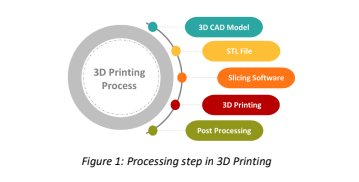
Once printing is complete, the wheel undergoes stress-relief heat treatment to reduce residual stresses, followed by support removal, surface finishing, and CNC machining for precise dimensions, bolt patterns, and hub interfaces.
2.2 Buy-to-fly Ratio:
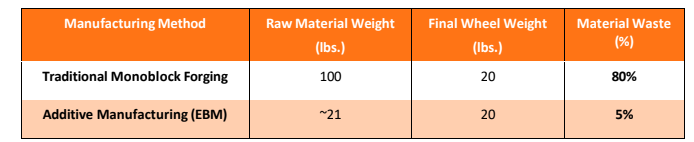
The graph below illustrates the drastic difference in material efficiency between traditional forging and additive manufacturing for wheel production.
2.3 Role of 3D printing w.r.t, vehicle’s wheels
Different role are:
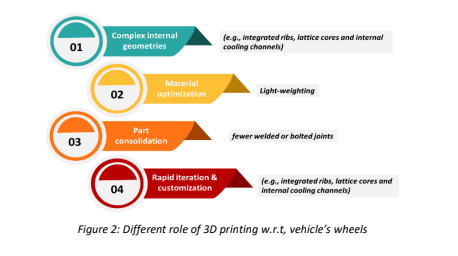
However, these benefits bring novel failure modes and material behavior concerns. In particular, anisotropic mechanical properties (due to the layer‐by‐layer build) and micro‐porosity (from incomplete fusion, trapped gas or powder defects) present potential threats to wheel safety, durability and certification
3. Limitations in 3D-Printed Wheels
The performance and safety of 3D-printed vehicle wheels depend heavily on the integrity of the printed metal. Among various technical hurdles, two critical limitations—porosity and anisotropy—dominate the current discourse in additive manufacturing (AM) of structural automotive components. These two phenomena fundamentally determine the mechanical reliability, fatigue life, and certification viability of 3D-printed wheels.
One of the most critical challenges in 3D‐printed vehicle wheels is the formation of micro‐porosity. During process methods such as powder bed fusion (PBF) or selective laser melting (SLM), small voids may form due to: incomplete powder fusion, entrapped gas bubbles, or contamination of powder feedstock. These pores - often on the order of microns - act as stress concentrators and initiation sites for fatigue cracks. The presence of these voids significantly compromises mechanical strength, fatigue life and durability under cyclic loading.
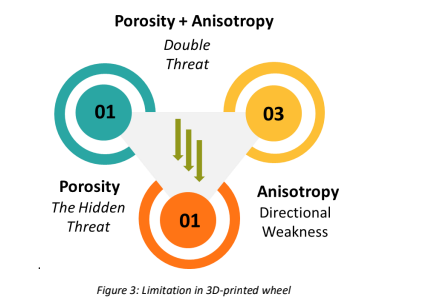
Another inherent issue with layer-based AM is anisotropy i.e. material properties vary depending on build orientation. In the layered manufacturing process, thermal gradients, solidification direction and cooling rates create a grain structure (often columnar) that is oriented along the build direction. This result in direction‐ dependent mechanical behavior: typically, strength and fatigue resistance along the build direction may be weaker than in‐plane directions. For a wheel, which must accept radial, tangential and lateral loads, non-uniform mechanical properties can lead to unpredictable performance — especially in high-stress situations (sharp turns, heavy braking, impacts).
When porosity and anisotropy combine, the risk is amplified. A pore aligned in a weak build direction may more easily propagate a crack under cyclic load; grain boundary orientation combined with a void can act as a preferential path for fatigue propagation. For vehicle wheels, where safety and long‐term durability are non- negotiable, these defects become critical.
4. Proposed Solutions to Reduce/Eliminate Porosity and Anisotropy in 3D Printing
To address the challenges posed by porosity and anisotropy, several advanced approaches have emerged. These solutions target the core material/process issues and aim to bring AM wheels into viable production.
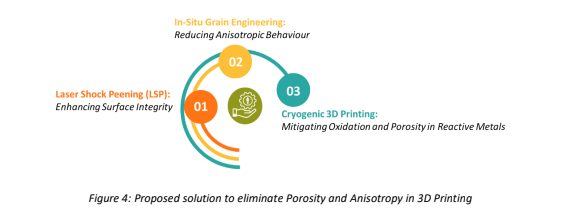
A. Laser Shock Peening (LSP): Enhancing Surface Integrity
Laser Shock Peening (LSP) is a post-processing technique for metal additive-manufactured components, including vehicle wheels. High-energy laser pulses generate shock waves that induce deep compressive residual stresses in the surface layer. This helps mitigate surface-connected porosity and anisotropy-related weakness, reduce crack initiation, and improve fatigue resistance.
B. In-Situ Grain Engineering: Reducing Anisotropic Behaviour
In-situ grain engineering refers to techniques applied during the AM build to influence the grain structure as the metal solidifies. For example, using electromagnetic (magnetic or electric) fields in the build chamber to influence solidification direction or applying controlled thermal gradients to promote equi-axed (rather than columnar) grain formation.
C. Cryogenic 3D Printing: Mitigating Oxidation and Porosity in Reactive Metals
For high‐performance vehicle wheels, materials such as titanium or high‐strength aluminium alloys may be used. These materials are more prone to oxidation, vaporisation and defect formation at high temperatures. Using a cryogenic printing environment (e.g., inert argon at –100 °C) helps suppress these defects.
5. IP Activity in Acoustic wave separation
As part of our analysis of patent activity in Porosity and Anisotropy in 3D-Printed Wheels: Challenges and Mitigation Strategies, an IP study was conducted to identify patents related to this technology and a total of 667 applications were selected for final analysis.
5.1 Relevant keywords, synonyms and classes used for search
- 3D Printing, Additive Manufacturing, Layer by Layer deposition, Rapid prototype
- Wheel, Rim, Alloy wheel, Car wheel, Road wheel
- Porosity, Anisotropy, Crack, Void, Gas pocket, Air Pocket, Impurity, Lack of Fusion
5.2 Graphical Analysis from the identified patents (667 patent applications):
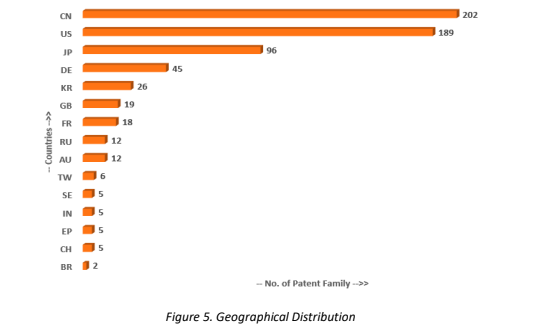
Figure 5. shows the distribution of patents across priority countries (top 15), providing insight into major R&D locations for Porosity and Anisotropy in 3D-Printed Wheels, China has most patent family i.e., 202, followed by US with 189 patent family. India holds 11th position.
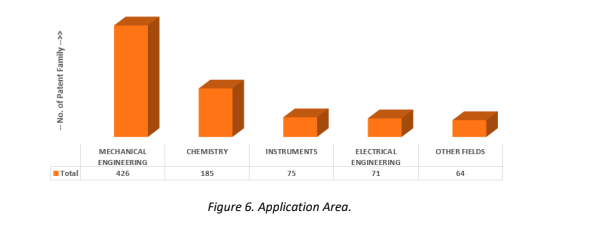
Figure 6. shows the application area of treatment of defects in Porosity and Anisotropy in 3D-Printed Wheels with a major focus on Mechanical Engineering, with 426 patents family in this domain. Chemistry hold at second place, with 185 patents family.
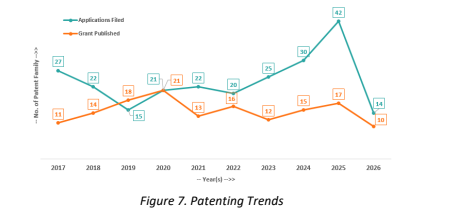
Figure 7. shows patenting trends, with zigzag growth of Granted patent from 2020 to 2025. Also graph shows the sharp inclination of patent filling from 2022 to 2025 and reaches its top.
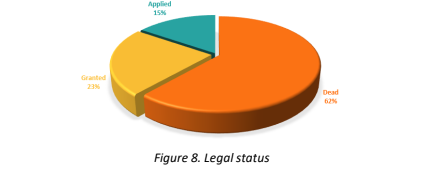
Figure 8. shows a pie chart demonstrating the total number of active (granted and applied) and inactive patents, with 38% patents categorized as “Active" and 62% as “Dead". Out of “Active” patent 23% are “Granted” and 15% are “Pending” application.
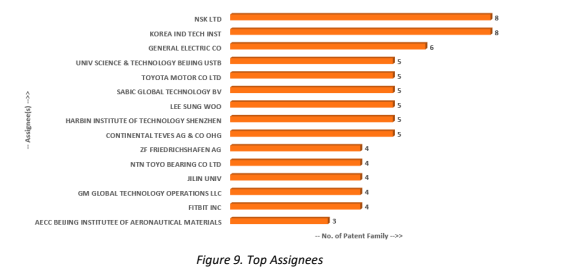
Figure 9. shows top patent assignees related to Porosity and Anisotropy in 3D-Printed Wheels, with the NSK Ltd & Korea Ind Tech Inst. leading with 8 patents, followed by the General Electric Co with 6 patents.
6. MARKET ANALYSIS:
6.1 Market Size (Forecasted)
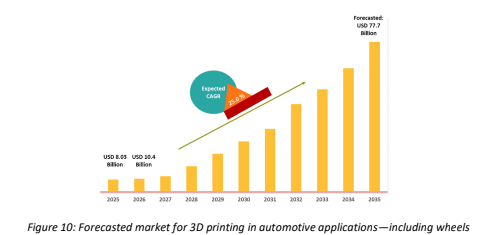
The global market for 3D printing in automotive applications—including wheels—is projected to grow from USD 8.3 billion in 2025 to USD 77.7 billion by 2035, representing a CAGR of 25.0%. This rapid expansion is driven by key innovations such as lightweight materials and customized wheel designs, which are crucial for electric vehicles and new propulsion trends.
In India and Asia-Pacific, alloy wheels (often produced with advanced methods like 3D printing and flow-forming) are becoming the dominant segment due to their lightweight, fuel efficiency, and customization potential. The demand is accelerated by EV adoptions and performance enhancements, with a market valuation of USD 8.3 billion for wheels in India alone. Key cities—Delhi, Mumbai, Bengaluru—serve as primary hubs for both manufacturing and innovation.
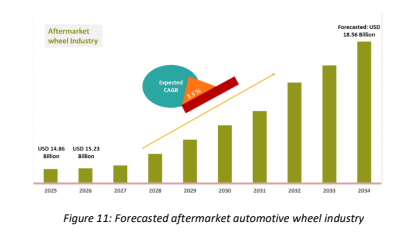
The global automotive wheels aftermarket industry size was valued at USD 14.86 billion in 2025 and is projected to grow from USD 15.23 billion in 2026 to USD 18.56 billion by 2034 at a CAGR of 2.5% during the forecast period 2026-2034. The global automotive wheels aftermarket is experiencing a shift towards lightweight materials like aluminum and alloy, which offer significant benefits in enhancing vehicle performance. These materials reduce the overall weight of vehicles, contributing to better fuel efficiency, improved acceleration, and superior handling.
7. Conclusion
3D printing has the potential to transform vehicle wheel manufacturing by enabling lightweight designs, reducing material waste, and offering greater design flexibility than conventional casting and forging methods. However, challenges such as porosity and anisotropic mechanical properties continue to limit its widespread adoption for safety-critical components like wheels. Advanced solutions, including Laser Shock Peening (LSP), in-situ grain engineering, and cryogenic additive manufacturing, show significant promise in improving structural integrity and fatigue performance. With continued advancements in materials, processes, and quality control, additive manufacturing is expected to play an increasingly important role in the future of automotive wheel production.
How Pitch Scientific Supports in Porosity and Anisotropy in 3D-Printed Wheels
As 3D-printed vehicle wheels evolve toward higher performance, safety, and production readiness, overcoming porosity and anisotropy is becoming a key area of technological and intellectual property development.
Pitch Scientific offers patent search and IP intelligence services can help you identify who is innovating, what technologies are already patented, where the competitive landscape is heading, and where opportunities for differentiation exist.
We can conduct focused searches covering technologies such as:
Laser shock peening (LSP),
In-situ grain engineering,
Cryogenic additive manufacturing,
Process-parameter optimization,
Thermal and solidification control,
Pore reduction,
Residual-stress management, and
Advanced post-processing techniques.
Our team can further analyse relevant patent portfolios, identify key competitors and technology leaders, evaluate potential prior-art and FTO risks, and uncover white-space opportunities that may support new product development and patent filing strategies. By leveraging our patent research expertise, you can make faster, evidence-based R&D and IP decisions while reducing the risk of investing in technologies that may be difficult to protect or commercialize.


