Executive Summary
Light Fidelity (Li-Fi) has emerged as one of the most promising optical wireless communication technologies. Instead of utilizing radio waves, Li-Fi employs the visible light spectrum generated by light-emitting diodes (LEDs) to transmit digital information at extremely high speeds. Unlike traditional wireless systems, Li-Fi converts LED lighting infrastructure into high-speed wireless access points by rapidly modulating light intensity at frequencies imperceptible to the human eye. A photodetector or optical receiver captures these variations and reconstructs the transmitted digital information. The technology is being explored for a wide range of applications, including smart buildings, healthcare facilities, aircraft cabins, industrial automation, underwater communication and defense systems.
This whitepaper presents the underlying principles of Li-Fi technology, system architecture, communication mechanisms, technical advantages, current research developments, intellectual property landscape, market outlook, and future opportunities for widespread deployment.
1. Introduction
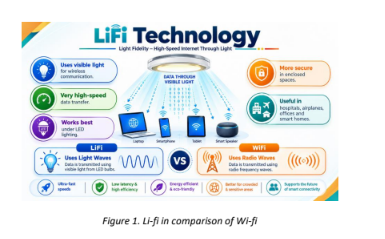
Li-Fi has started growing in popularity since the IEEE802.11bb standard was established. This standard specifies the requirements for wireless communication utilizing light waves. However, problems with irregular Wi-Fi signals and slow internet access persist, especially in situations with high network congestion or physical barriers that might impair the reliability and speed of wireless connections. These difficulties frequently result in variable performance, failed connections [3], and lengthier loading times, making for an unsatisfactory user experience, particularly in distant or densely populated places where internet infrastructure may be inadequate or overcrowded. Wireless communications mainly use electromagnetic wave theory. In this capacity, electromagnetic waves have limitations, which means they cannot meet the growing demand for data transmission.
Currently, the new technology known as “Light Fidelity” (Li-Fi) offers a potential answer to these difficulties by using the visible light spectrum for wireless data transfer, rather than traditional methods that rely on radio frequencies. Li-Fi is a promising advance in communication technology, offering quicker data transmission rates, increased security, and less interference.
2. Problem Statement
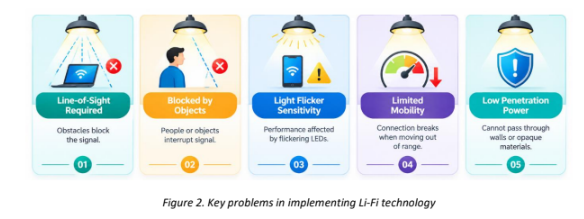
LiFi technology offers high-speed, secure, and interference-free wireless communication using light. However, its widespread adoption is limited by challenges such as line-of-sight requirements, limited coverage, and dependence on suitable lighting infrastructure. Addressing these limitations is essential to realize LiFi’s potential as a reliable complement to conventional RF-based wireless communication.
3. Purposed Solution: Technology Overview
3.1 What is Li-Fi?
Light Fidelity (Li-Fi) is a bidirectional, high-speed optical wireless communication technology that uses modulated light rather than radio waves to transmit data between devices. Li-Fi belongs to the broader category of optical wireless communication (OWC), which encompasses infrared remote control links, free-space optical links, and visible light communication (VLC).
3.2 How Li-Fi Works
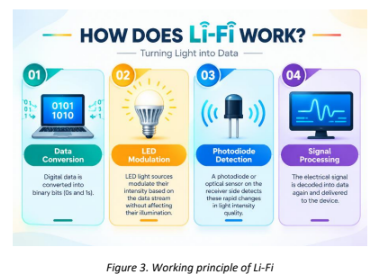
Visible light communication (VLC) technology, which is the backbone of LiFi-based data transfer systems; works by modulating the light waves of an LED transmitter at a very high speed to carry information. The working of the Li-Fi is as follows:
- The LiFi router receives the information via the Ethernet cable that connects it to the local network
- It transmits it to the LED bulb, which fluctuates at high speed, with a frequency of tens of thousands or even millions of signals per second.
- The light signal is perceived by the LiFi key which transforms it into an electrical signal and transmits it to the computer
- The computer translates the signal into information that can be understood by humans.
3.3 Components
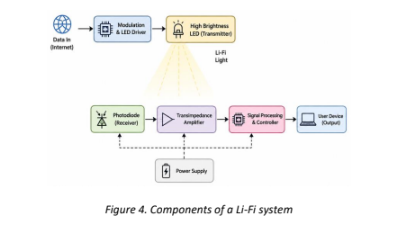
Main component of the Li-Fi system are as follows:
3.4 Performance Considerations
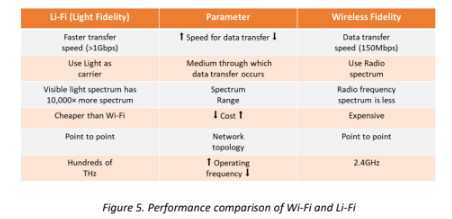
Li-Fi is a prospective replacement for Wi-Fi as Li-Fi is expected to be faster (16 times faster than Wi- Fi) and consumes less electricity (due to the shared usage between wireless network transmitter and home lighting). Therefore, Li-Fi usage will contribute in reducing the electricity and generator fuels (e.g. Coal, Oil and Gas) usage. Furthermore, Li-Fi usage will reduce the pollution caused by electric generators.
3.5 Quantitative Comparisons
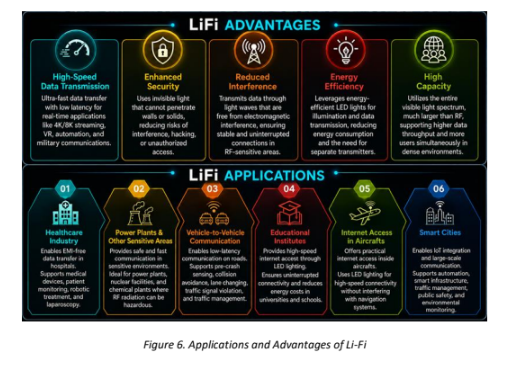
4. Advantages and Applications of Li-Fi technology
5. IP Activity in Solar powered Vehicles
As part of our analysis of patent activity in Li-Fi technology, an IP landscape study was conducted to identify patents related to visible light communication, LED-based transmitters and receivers, optical modulation, data transmission, photodetectors, Li-Fi networking, indoor positioning, and hybrid Li- Fi/RF communication systems. A total of 3308 patent families were analyzed, and 930 patent applications were selected for final analysis.
5.1 Relevant keywords, synonyms and classes used for search
- Li-Fi, Light Fidelity, Visible light communication, VLC, LED communication, Light Data transmission, Optical wireless communication
- Light modulation, Photodetector receiver, Optical transmitter, Light sensor
- Relevant patent classification includes H04B10/116, H04B10/1149, H04B10/502, H04B10/1143, H04B10/11, H04B10/516 and H04B10/69
5.2 Graphical Analysis from the identified patents (930 patent families):
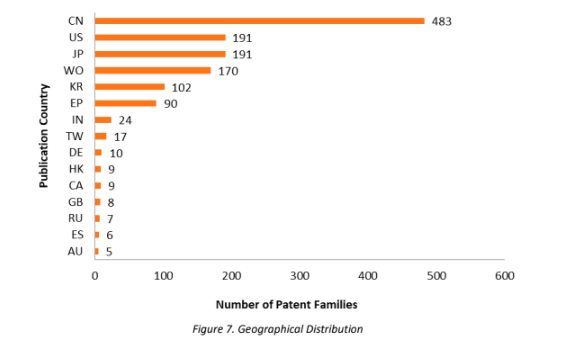
Figure 7 shows the distribution of patents across priority countries, providing insight into major R&D locations for Li-Fi technology, China has most patents i.e., 483, followed by US with 191 patents.
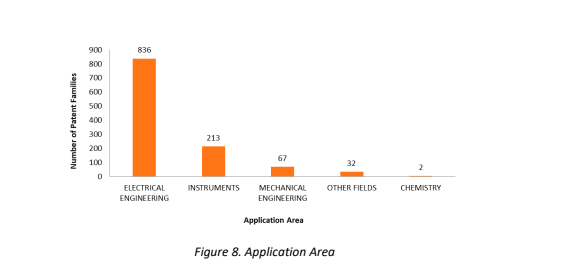
Figure 8 shows the application area of Li-Fi technology with a major focus on Electrical Engineering, with 836 patents in this domain. Instrumentation, also receive considerable attention, with 213 patents.
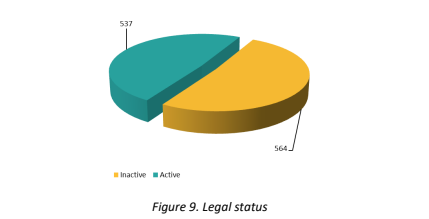
Figure 9 shows a pie chart demonstrating the total number of active and inactive patents, with 537 patents categorized as “Active" and 564 as “Inactive".
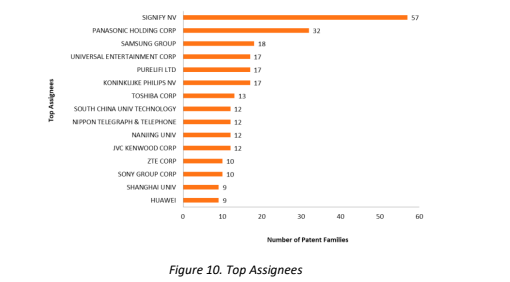
Figure 10 Shows top patent assignees, with the Signify NV leading with 57 patents, followed by Panasonic with 32 patents.
6. Market and Commercial Outlook
6.1 Market Potential
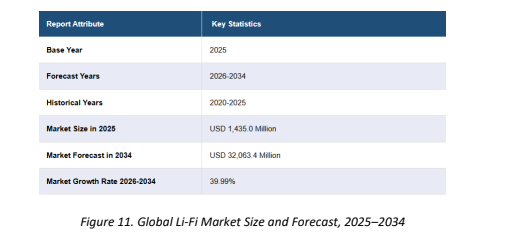
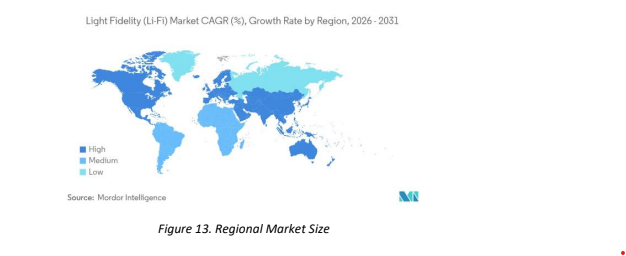
The global Li-Fi market size was valued at USD 1,435.0 Million in 2025. Looking forward, IMARC Group estimates the market to reach USD 32,063.4 Million by 2034, exhibiting a CAGR of 39.99% from 2026-2034. Asia Pacific currently dominates the market, due to the rising demand for high- speed internet, ongoing technological advancements, smart building initiatives, and expansion of the Internet of Things (IoT) are primarily driving the market's growth.
6.2 Global Market Dynamics
The global Li-Fi market is segmented into North America, Europe, Asia Pacific, Latin America, and the Middle East & Africa. Asia Pacific currently represents the leading regional market, supported by increasing demand for high-speed Internet, technological advancements, smart-building initiatives and expansion of IoT applications. North America and Europe represent important commercial markets because of their advanced digital infrastructure and adoption of specialized wireless connectivity solutions.
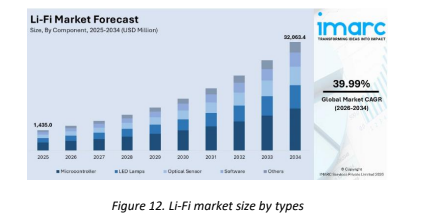
North America leads the Li-Fi market with 38.42% of 2025 revenue, supported by cybersecurity needs, defense spending, widespread LED adoption, and local manufacturing. Asia-Pacific is expected to grow fastest at a 43.29% CAGR through 2031, driven by government-backed smart city and industrial projects, secure communications, and expanding component ecosystems. Europe is also a strong market due to EMC and privacy regulations, while Middle East & Africa and Latin America are emerging markets where pilot projects in critical infrastructure and logistics could drive future growth.
6.3 Market Players
6.4 Case Studies
7. Conclusion
LiFi Technology is an innovative wireless communication system that uses visible light to transmit data at very high speeds. It offers significant advantages such as enhanced security, high bandwidth, and energy efficiency. Although it has certain limitations like limited range and dependence on light availability, its potential applications in healthcare, aviation, and smart infrastructure make it an important development in modern communication technology.
How Pitch Scientific Supports Innovation in Li-Fi Technology
Pitch Scientific combines expertise in Li-Fi, Visible Light Communication (VLC), and Optical Wireless Communication (OWC) with IP intelligence to help clients navigate emerging technologies in LED- based data transmission, optical communication systems, and next-generation wireless connectivity.
We support clients across the Li-Fi technology lifecycle through:
- Prior Art & Patentability Searches:Identify relevant patents and prior art to assess the novelty and patentability of innovations in neural codec architectures, machine learning-based compression algorithms, and AI-driven video encoding and decoding
- Freedom-to-Operate (FTO) Analysis:Evaluate potential patent risks associated with developing and commercializing neural video codecs, deep learning-based compression models, and AI-enabled video processing solutions.
- Patent Landscape & Competitor Analysis:Map global patent portfolios, key players, emerging technologies, and innovation trends across neural video compression, learned codecs, and machine learning-based multimedia processing.
- White-Space Analysis:Identify technology gaps and emerging opportunities to guide future R& D and patent filing strategies in optical wireless communication.
- Technology & Patent Analysis:Analyze innovations involving LED drivers, photodiode receivers, optical modulation, MIMO, signal processing, beamforming, and hybrid Li-Fi/Wi-Fi systems.
- IP Commercialization & Licensing Support: Help clients assess and position their patent portfolios, identify potential licensing opportunities, and explore commercialization strategies.
- Ongoing Patent Monitoring:Track new patent filings, grants, emerging neural codec architectures, competitor activities, and developments in AI-driven video compression to help clients stay informed about the evolving technology landscape
By combining technical expertise in optical wireless communication with strategic IP intelligence, Pitch Scientific helps clients reduce IP risks, strengthen patent portfolios, identify technology opportunities, and accelerate the development and commercialization of next-generation Li-Fi solutions.
References
1. https://www.researchgate.net/publication/396869167_Comprehensive_analysis_of_Li- Fi_technology_positioning_algorithms_security_vulnerabilities_and_future_IoT_applications2. https://technav.ieee.org/topic/light-fidelity/
3. https://sci-hub.su/10.1109/JLT.2015.2510021
4. https://www.rfpage.com/li-fi-technology-working-principle-and-applications/
5. https://www.oledcomm.net/blog/advantages-disadvantages-of-lifi/
6. https://www.researchgate.net/publication/333972579_Performance_and_Environmental_Impa cts_Review_of_Li-Fi_and_Wi-Fi_Technologies
7. https://www.wiprolighting.com/blog/visible-light-communication-li-fi-and-its-application
8. https://www.fortunebusinessinsights.com/li-fi-light-fidelity-market-104823
9. https://www.databridgemarketresearch.com/reports/global-li-fi- market?srsltid=AfmBOoo7pFkIwYkme8tT4BMCsVctIWkBL4l0fxCpSL78J6OabrBuK-2i
10. https://www.mordorintelligence.com/industry-reports/li-fi-market
11. https://www.imarcgroup.com/li-fi-market
12. https://www.signify.com/global/our-company/news/press-releases/2019/20190909-reporting- at-light-speed-with-lifi
13. https://www.signify.com/global/innovation/trulifi/philips-stadium
14. https://www.signify.com/global/our-company/news/press-releases/2019/20190221-signify- reports-rush-to-trial-lifi
15. https://www.oledcomm.net/blog/news/lifi-takes-off-in-the-aeronautics-sector
16. https://www.business-standard.com/content/press-releases-ani/nav-wireless-betting-big-on- the-use-of-lifi-technology-for-covid-19-treatment-120081801108_1.html
17. https://www.vedantu.com/general-knowledge/lifi-technology


